Alex Soto
Serverless-Native Java with Quarkus
#1about 2 minutes
Understanding the core principles of serverless computing
Serverless computing abstracts away server management and scales applications based on exact demand, including scaling to zero to reduce costs.
#2about 3 minutes
Choosing between microservices and serverless architectures
Compare microservices for long-lived, developer-controlled processes against serverless for short-lived, cloud-managed, event-driven functions.
#3about 3 minutes
Implementing serverless workloads on Kubernetes with Knative
Knative enables serverless, container-based workloads on Kubernetes by using standard primitives to manage scaling, revisions, and traffic.
#4about 2 minutes
Solving Java's serverless challenges with Quarkus
Quarkus overcomes traditional Java performance issues in serverless environments by offering sub-second startup times and a minimal memory footprint.
#5about 4 minutes
Generating a new Quarkus project for serverless development
Use the code.quarkus.io starter to quickly generate a new project with dependencies for JAX-RS, Spring Web, or AWS Lambda.
#6about 5 minutes
Deploying a Quarkus app and demonstrating scale to zero
A live demo shows a native-compiled Quarkus application starting in milliseconds and automatically scaling down to zero pods after a period of inactivity.
#7about 3 minutes
Comparing Quarkus and Spring Boot startup performance
A side-by-side comparison demonstrates that a native Quarkus application starts in milliseconds while a similar Spring Boot application takes several seconds.
#8about 3 minutes
Implementing blue-green deployments with Knative revisions
Knative's revision system allows for safe deployment strategies like blue-green by managing traffic splitting between different versions of a service.
#9about 4 minutes
Auto-scaling Knative services based on traffic load
Configure a Knative service to automatically scale up the number of pods based on a target number of concurrent requests.
#10about 3 minutes
Using Knative eventing for asynchronous workloads with Kafka
Knative Eventing can consume messages from a Kafka topic and automatically trigger and scale services to process events asynchronously.
#11about 5 minutes
Debugging serverless applications in a production environment
Use tools like Telepresence or adjust the scale-to-zero timeout to connect a local debugger to a running service in a Kubernetes cluster.
Related jobs
Jobs that call for the skills explored in this talk.

Matching moments
02:39 MIN
Key takeaways for building portable serverless Java applications
Serverless Java in Action: Cloud Agnostic Design Patterns and Tips
Unlock full access
Log in or set up an account to access this feature and more.
07:05 MIN
Java's adaptation for cloud-native and serverless computing
Build ultra-fast In-Memory Database Apps and Microservices with Java
Unlock full access
Log in or set up an account to access this feature and more.
02:07 MIN
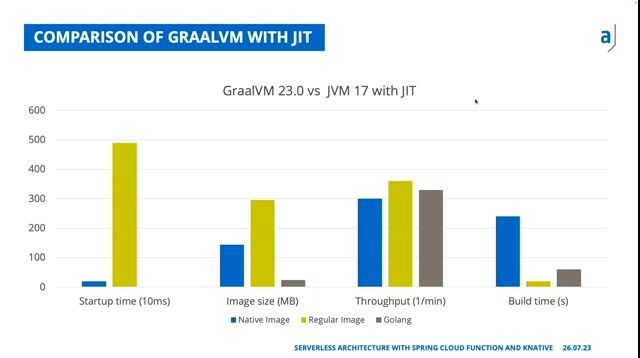
Using Quarkus and GraalVM for fast Java startup
Serverless Java in Action: Cloud Agnostic Design Patterns and Tips
Unlock full access
Log in or set up an account to access this feature and more.
03:11 MIN
Optimizing Java performance for cloud-native applications
Cloud Chaos and Microservices Mayhem
Unlock full access
Log in or set up an account to access this feature and more.
01:26 MIN
Why traditional Java was too slow for serverless
Serverless Java in Action: Cloud Agnostic Design Patterns and Tips
Unlock full access
Log in or set up an account to access this feature and more.
04:59 MIN
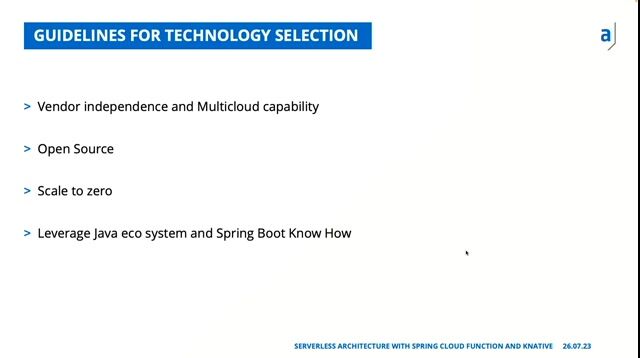
Choosing a technology stack for serverless Java applications
Serverless Architectures with Spring Cloud Functions and Knative
Unlock full access
Log in or set up an account to access this feature and more.
03:42 MIN
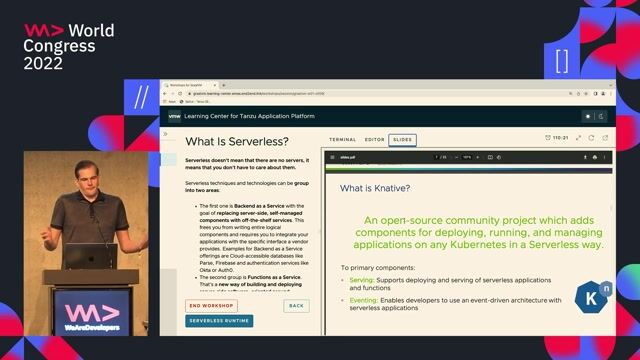
Introducing Knative as a serverless runtime for Kubernetes
Going serverless using the Spring Framework ecosystem
Unlock full access
Log in or set up an account to access this feature and more.
04:31 MIN
Exploring alternatives and ideal use cases for FaaS
Serverless Architectures with Spring Cloud Functions and Knative
Unlock full access
Log in or set up an account to access this feature and more.
Featured Partners
Related Videos
 27:11
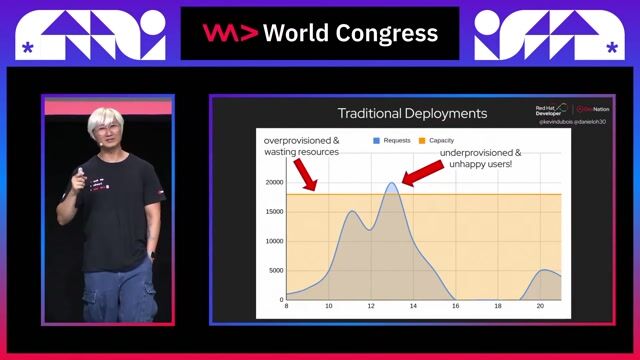
27:11Serverless Java in Action: Cloud Agnostic Design Patterns and Tips
Kevin Dubois & Daniel Oh
 37:55
37:552021: Familiar APIs on Kickass Runtimes #slideless
Adam Bien
 44:40
44:40Quarkus. A Bliss for developers
Alex Soto
 39:10
39:10Development of reactive applications with Quarkus
Niklas Heidloff
 44:20
44:20High performance Serverless Java on AWS
Vadym Kazulkin
 49:30
49:30Microservices with Micronaut
Moritz Kammerer
 45:00
45:00Going serverless using the Spring Framework ecosystem
Timo Salm
 28:21
28:21Developer Joy with Quarkus
Daniel Oh
Related Articles
View all articles


.gif?w=240&auto=compress,format)
From learning to earning
Jobs that call for the skills explored in this talk.


PROSOZ Herten GmbH
Herten, Germany
Junior
Intermediate
Senior
Java
Scrum
Kotlin
Microservices


Buhck Umweltservices GmbH & Co. KG
Reinbek, Germany
Senior
Java
React


Akros Ag
Junior
Docker
Jenkins
Openshift
Kubernetes
Microservices
+1
Akros Ag
Junior
Docker
Jenkins
Openshift
Kubernetes
Microservices
+1
Akros Ag
Junior
Docker
Jenkins
Openshift
Kubernetes
Microservices
+1
Callista Group
Basel, Switzerland
Senior
Apache Kafka
Microservices